
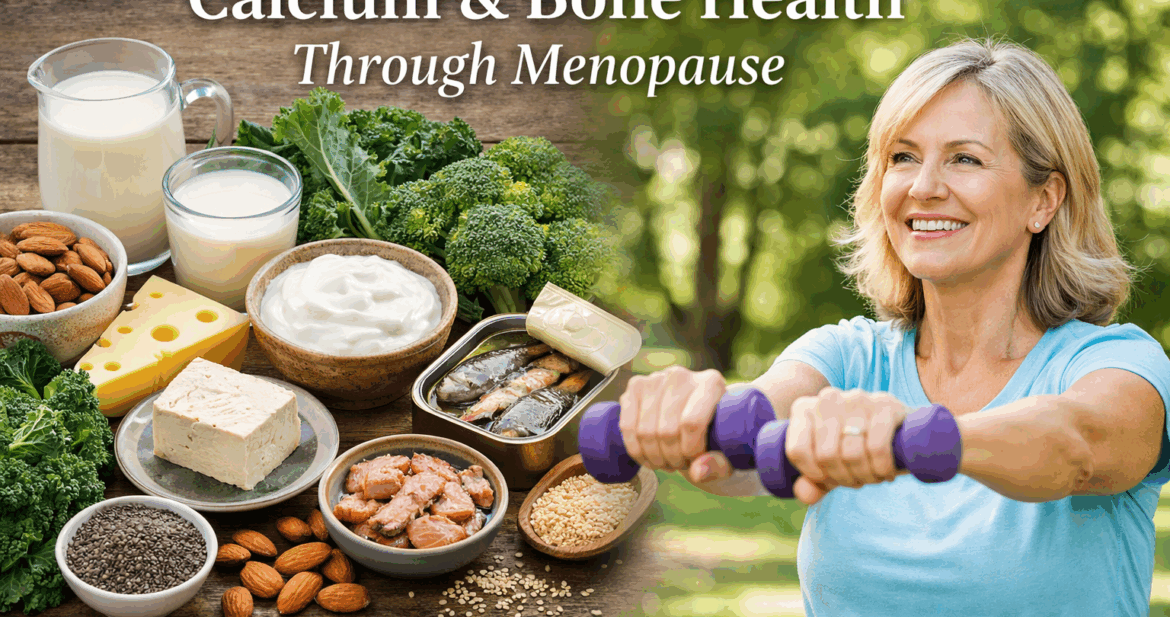
Calcium is often reduced to a single number, “How much should I take?” but the research tells a more nuanced story.
Studies repeatedly show that higher calcium intake alone does not help bones long-term. In fact, according to Washington University School of Medicine researchers, women who get most of their daily calcium from food have healthier bones than women whose calcium comes mainly from supplemental tablets. Surprisingly, this is true even though the supplement takers have a higher average calcium intake.
A woman’s calcium needs change across the lifespan, especially through menopause, and how calcium is consumed, including dose size, form, and timing, directly affects how well it is absorbed and used by the body.
Understanding these details can make the difference between simply taking calcium and actually supporting long-term bone health.
How Calcium Needs Change Before and After Menopause
Before menopause, estrogen helps regulate bone remodeling by balancing bone breakdown and formation. During this phase, most women require about 1,000 mg of calcium per day to maintain bone density.
After menopause, falling estrogen levels accelerate bone loss and reduce calcium retention. Research consistently shows that postmenopausal women benefit from a slightly higher intake, around 1,200 mg of calcium per day, to help slow age-related bone loss and reduce osteoporosis risk. Importantly, this is a total daily amount from both food and supplements combined.
Honestly, this is not difficult to obtain through food. See below for an example.
Note: More calcium is not better. Intakes above recommended upper limits do not improve bone outcomes and may increase the risk of kidney stones or other health concerns in some individuals.
Food First: The Best Way to Get Calcium
From a nutritional and functional perspective, food is the preferred source of calcium whenever possible. Calcium-rich foods provide additional nutrients that support bone health, including protein, magnesium, phosphorus, and potassium.
Some of the most bioavailable food sources include:
- Dairy products such as milk, yogurt, and cheese
- Fortified plant milks and fortified foods
- Tofu made with calcium sulfate
- Sardines and canned salmon with bones
- Leafy greens like kale and collards, which are lower in oxalates than spinach
Spacing calcium-rich foods across meals also supports better absorption, rather than trying to meet your needs in one sitting.
Example of 1000 mg calcium via food, from the National Institute of Health:
| Food | Amount | Approx. Calcium (mg) |
|---|---|---|
| Rye/whole grain bread | 2 slices | 100 |
| Gouda/Edam/Emmental cheese | 2 slices | 400 |
| Broccoli | 1 serving | 50 |
| Mineral water | 2 x 200 ml | 100 |
| Yogurt | 200 g | 350 |
| Total | 1,000 mg |
Note: Calcium-fortified foods, such as plant milks, juices, and calcium-set tofu, can be a useful option when dietary intake from whole foods is insufficient and dependent on the form. However, whole food sources remain ideal, as they provide additional nutrients and cofactors that support calcium absorption and long-term bone health.
When Supplements Are Helpful
Some women struggle to meet calcium needs through food alone. Perhaps due to lack of access to whole food, or recent surgeries requiring more nutrients, or internal inhibition to absorption. In these cases, supplements can be useful, but the type of calcium matters.
- Calcium citrate, which is well absorbed, gentler on digestion, and can be taken with or without food
- Calcium “mixed amino acid chelate” blend, a form which enhances absorption by bringing calcium into the body still attached to amino acids (just as it would be in food) – eg., magnesium glycinate
- MCHC (Microcrystalline Hydroxyapatite), a form that mimics the exact multi-mineral compound in bone tissue which physiologic ratios of calcium, phosphorus, and (often)other key trace minerals
- AlgaeCal, a natural, mixed amino-acid-chelate, plant-based calcium coming from algae.
- Calcium carbonate or oxide are both widely-available, but cheap and poorly absorbed. Must be taken with food.
Note: Calcium can impair iron; take these supplements separately! This is true with food too (example: cheese on a burger).
How Much Calcium to Take at One Time
One of the most overlooked aspects of calcium supplementation is dose size. Research shows that the body can efficiently absorb only about 500–600 mg of elemental calcium at a time. Larger doses lead to reduced absorption efficiency, meaning more calcium passes through the body unused.
For this reason, calcium intake should be spread throughout the day. For example:
- A daily goal of 1,000 mg may be best met with two doses of 500 mg
- A daily goal of 1,200 mg may be split into two or three smaller doses
This applies to both supplements and food, reinforcing the benefit of distributing calcium intake across meals.
Supporting Nutrients That Help Calcium Do Its Job
Calcium does not work in isolation. Several nutrients and lifestyle factors are essential for proper absorption and bone incorporation. Strong bones are fortified with and require a rich mix
of minerals, including magnesium, boron, strontium, manganese, phosphorus, copper, and
zinc, along with calcium.
- Vitamin D is critical for intestinal calcium absorption. Without adequate vitamin D, even sufficient calcium intake may be ineffective
- Magnesium and vitamin K2 help guide calcium into bone (vs. allowing it to wander around to more dangerous places like your kidneys to form stones or arteries to become part of plaque).
- Protein supports bone structure
- Weight-bearing and resistance exercise signal the body to use calcium to strengthen bones
- Managing chronic stress and inflammation supports healthier bone remodeling over time
Note: ask your doctor to test your calcium, Vitamin D3, magnesium and K2 status so you have a baseline starting point.
Calcium Around the World: Beyond Dairy
Interestingly, not all cultures rely heavily on milk for calcium, yet many populations maintain strong bones well into older age. For example:
- Japan and China traditionally consume very little dairy, yet historically have had lower rates of osteoporosis and hip fractures compared with Americans. Their diets emphasize calcium-rich vegetables, tofu made with calcium sulfate, small fish eaten with bones, seaweed, and fermented foods, often combined with regular weight-bearing activity
- In Mediterranean countries, bone health is supported by nuts, seeds, leafy greens, legumes, and moderate dairy, along with a diet rich in vitamin K, magnesium, and healthy fats
These examples highlight that bone health is multifactorial. Calcium intake is important, but it works best alongside other nutrients, lifestyle factors, and overall diet quality. This may explain why populations with lower dairy consumption sometimes have fewer bone health problems than Americans who rely heavily on milk but may have less active lifestyles or lower intake of supportive nutrients.
The Bottom Line
For bone health, especially through menopause, strategy matters more than the number alone. Most women need 1,000 mg per day before menopause and 1,200 mg per day after menopause, ideally from food first, with supplements used thoughtfully when needed. Choosing well-absorbed forms, keeping doses under 500–600 mg at a time, spreading intake across meals, and pairing calcium with supportive nutrients and movement creates the strongest foundation for healthy aging bones.
********
If you are interested in reading more in-depth research on this topic, here are Clinical References on Calcium Needs, Absorption, and Supplementation:
- Mayo Clinic. Calcium supplements: Do’s and don’ts. Link
- American Association of Clinical Endocrinologists / Endocrine Society. Guidelines for prevention and treatment of osteoporosis. Link
- International Osteoporosis Foundation. Calcium and bone health recommendations. Link
- StatPearls. Calcium Supplementation and Absorption. Link
- North American Menopause Society. Bone health in peri- and postmenopausal women. Link
- Journal of Bone and Mineral Research. Calcium supplementation and bone density in postmenopausal women. Link
- PMC. Clinician’s guide to calcium supplementation and fracture prevention. Link